Letting an AI agent take real actions in customer support, without losing control
The real question about AI in support is not whether an agent can answer (it can). It is whether you can let it refund an order or reply to a customer without losing control. Here is how to give an AI agent real responsibility, on a leash.
Deskwoot Team
5 min read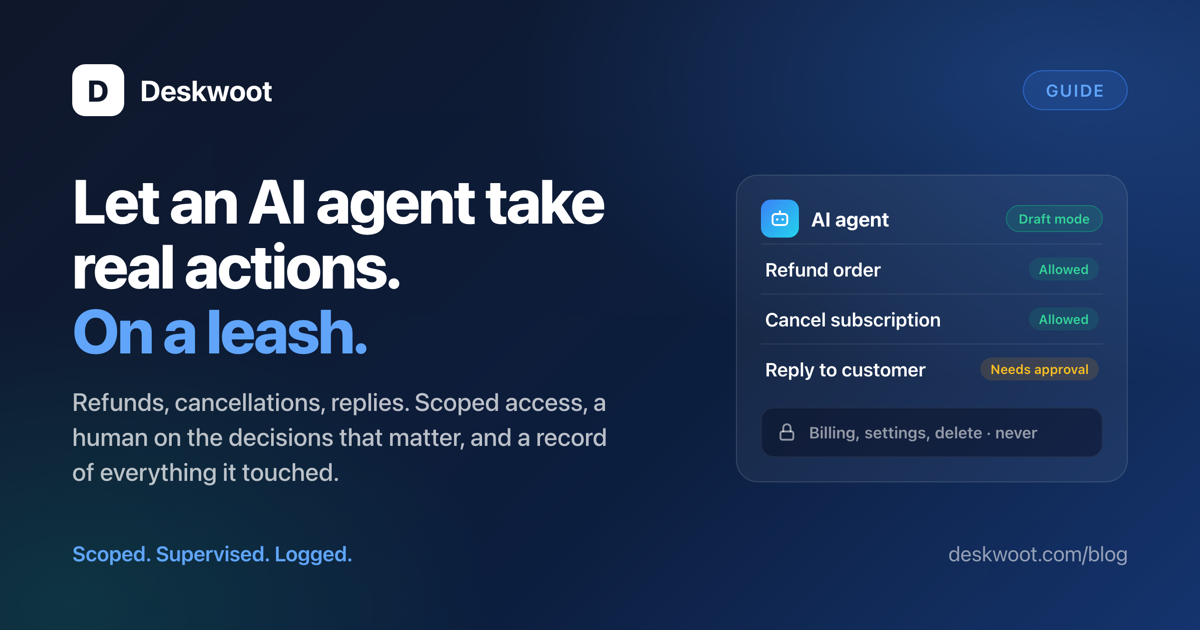
Contents
- Support bots used to answer. Now they act.
- Can an AI agent actually take customer support actions?
- The risk is not a wrong answer. It is an unsupervised action.
- What it takes to trust an AI agent with real actions
- What this looks like in Deskwoot
- Will AI take over customer support?
- Give it a leash, and it earns the responsibility
The question worth asking about AI in customer support in 2026 is not whether an agent can answer a ticket. It can. The real question is whether you can let it take actions, reply to a customer, refund an order, cancel a subscription, without it doing something you cannot take back. The answer is yes, but only if the agent works on a leash: scoped access, a person on the decisions that matter, and a record of everything it touched. Here is how to set that up so an AI agent earns real responsibility instead of just drafting text in a sandbox.
Support bots used to answer. Now they act.
For years an AI support bot meant a chatbot: it read your help center and wrote a reply. Useful, but it never touched anything real. The shift now is that agents can operate your actual help desk. Through a protocol like MCP (the Model Context Protocol), an agent connects to your support tool and gets a defined set of actions it can call: read the conversation, reply on the right channel, leave a private note, refund the order, cancel the subscription, update the contact. That is the difference between a bot that talks and an agent that works. It is also where the nerves start, because an agent that can act can act wrongly.
Can an AI agent actually take customer support actions?
Yes, and that is no longer the hard part. A connected agent can send a reply, issue a refund through Stripe, Shopify, or WooCommerce, cancel an order, change a status, or start an outbound message, all inside the system your team already uses. The capability was never the problem. The problem is doing it safely, inside the workflows and limits you set, so a confident mistake or a prompt-injection from a clever customer cannot turn into a real-world loss.
The risk is not a wrong answer. It is an unsupervised action.
A wrong reply is embarrassing and fixable. A wrong refund, a subscription cancelled for the wrong customer, a mass message sent by accident, those cost money and trust, and some of them cannot be undone. So the goal is not to hand an agent everything and hope. It is to give it exactly what the job needs, keep a person on the actions that carry real consequences, and make every action visible. Treat the agent like a new teammate in their first week: real access, clear limits, nothing irreversible without a second pair of eyes.
What it takes to trust an AI agent with real actions
Five controls turn a risky bot into one you can actually rely on.
Scoped access, not a master key. The agent should get only the permissions you grant: read, reply, manage contacts, and you should be able to limit it to specific inboxes. A support agent has no business reaching billing or settings, so it simply should not have a key to them.
A human on the reply, whenever you want one. The safest starting point is supervised, or draft-only, mode: the agent reads and proposes a reply, and a teammate approves or edits it before anything reaches the customer. You keep the speed of automation and the safety of a person in the loop, and you can loosen the leash as your confidence grows.
Hard limits on money. Refunds and cancellations should sit behind their own permission, off by default, and the same caps your team already trusts: a maximum amount, an order-age window, a status check, a cooldown. The agent acts within those rails or it does not act.
A boundary it can never cross. Some things should be flat-out unavailable to any agent: changing account settings, touching billing, deleting data, sending mass broadcasts, managing webhooks. If those are simply not in the agent's tool set, a prompt-injected bot has nothing dangerous to reach for.
A record of everything, and an instant kill switch. Every action the agent takes should be attributed to it in an audit log, so you can always see what it did and when, and the token should be revocable on the spot. Pull it, and the agent loses access immediately.
What this looks like in Deskwoot
This is exactly how Deskwoot's MCP server works. You connect an agent (OpenClaw, Claude, or any MCP client) with a scoped bot token you control. You can put a token in draft-only mode, where it reads and proposes replies but cannot send anything to a customer until a teammate approves it. Money actions like refunds and cancellations sit behind their own permission and the same caps your team uses, and the agent can never touch account settings, billing, data deletion, or mass broadcasts. Every action is logged to the agent's own service account, and you can pull its access in one click. If you want the step-by-step, the guide to connecting an AI agent over MCP walks through it.
Will AI take over customer support?
Not in the way the headlines suggest. The teams getting real value are not swapping their people for a model. They are letting an agent handle the volume, the routine refunds, the order-status questions, the repeat replies, and keeping their team on the judgment calls and the actions that carry weight. The human moves from typing the same answer over and over to approving, correcting, and handling the cases that actually need a person. That is the version of AI support that scales without the blowups.
Give it a leash, and it earns the responsibility
AI agents are about to do real work in support, not just talk about it. The teams that win will not be the ones with the cleverest model. They will be the ones who gave their agent safe, scoped access to the system where the work happens, kept a person on the decisions that matter, and could see and undo everything it did. Start it supervised, watch the audit log, widen the leash as it earns trust. That is how an AI agent goes from a demo to a teammate.

