Toothache at 9 pm: the one reply your practice chat should always give
When a patient writes about pain after closing, your chat should not weigh what they describe. Give everyone the same reply with your number, your acute slots, the out of hours service and the emergency number, and handle the rest on Monday.
Contents
9:12 pm, Sunday. Your practice chat gets this: "My tooth has been throbbing since this afternoon and my cheek feels a bit swollen. Can I come in tomorrow?" Whoever answers will want to judge how bad that sounds.
That instinct is the risk. Here you get one fixed reply for every patient in pain, the 4 parts it needs, 3 versions to copy and 7 test messages.
Why the reply must not depend on what the patient writes
Swelling sounds worse than throbbing. So whoever answers, a teammate on their phone or a chatbot, may want to say "come in first thing".
The safe answer is the same text for every patient, whatever they describe: your phone number, your rule for acute slots, the out of hours service and the emergency number.
What EU law looks at
In the EU, software becomes a medical device through its intended purpose. That purpose is read from more than the manual.
The Medical Device Coordination Group's guidance MDCG 2019-11 rev. 1 (June 2025) quotes the MDR definition: the use the manufacturer states "in the instructions for use or in promotional or sales materials or statements".
The same guidance draws the line that matters for a practice chat:
- Hospital information systems, which handle things like admission and "scheduling patient appointments", are "not in themselves qualified as medical devices" (page 25).
- Communication systems such as email are "normally based on software for general purposes, and do not fall within the definition of a medical device" (page 27).
- Software "intended to provide information which is used to take decisions with diagnosis or therapeutic purposes" falls under Rule 11 and is class IIa or higher (page 17).
Now picture a chat that tells "swollen" to come at 8 and tells "sensitive to cold" to book next week. It sorts patients by what they describe. That looks a lot more like Rule 11 software than like an appointment system.
The same line in the US
Section 520(o)(1)(A) of the FD&C Act keeps software "intended for administrative support of a health care facility", appointment schedules included, out of the device definition (FDA). Clinical functions are a separate question.
Trained people find this hard too
A 2011 report in the German Ärzte Zeitung on practice phones said the big difficulty for medical assistants is recognizing a real emergency on the phone. It advised a checklist the team works out with an emergency trainer.
A chat window at 9 pm has neither the trainer nor the checklist, so it should not try. Its job is to give the patient the routes to people who can.
This is general information, not legal advice. If your chat does more than share fixed contact routes, have the setup checked.
The 4 parts of a dental office after hours message
- Your phone number, and when someone answers it. "Call 0123 456789" is half an answer at 9 pm. "Call us on 0123 456789 from 8 am on Monday" is a whole one.
- Your rule for patients in pain. If you keep slots every morning, say exactly that, with the time the phone opens, so patients call at 8:00 and not at 10:30 when the slots are gone.
- The out of hours service for your area. This part depends on the country, so check the table below.
- The emergency number for when life may be in danger. Put it in every version, so nothing has to decide when to show it.
Emergency numbers and dental help by country
| Where | Emergency number | Dental help outside your hours |
|---|---|---|
| Anywhere in the EU | 112, free of charge (European Commission) | Depends on the country |
| England | 999 | The NHS tells patients to contact a dentist, or to use 111 or 111 online (NHS) |
| Germany | 112 | No nationwide number. The regional Kassenzahnärztliche Vereinigung organizes the dental service and access differs by state; 116117 is the service for doctors (Federal Ministry of Health) |
| US | 911 | Your own number for patients of record (ADA) |
| Brazil | SAMU 192, free, 24 hours (Ministério da Saúde) | Your local arrangement |
US practices: match your voicemail
For US practices the written reply is the twin of your voicemail. The ADA's practice guidance says the after hours voicemail should give patients of record a number to reach you.
It should also "clearly advise callers with a life threatening emergency to dial 911 or immediately go to the emergency department of the nearest hospital".
Section 4.B of the ADA Code (advisory opinions revised to March 2023) obliges dentists to "make reasonable arrangements for the emergency care of their patients of record".
Use the same number in the chat as on the voicemail. In the "after closing" version below, it takes the place of the out of hours service.
What stays out of the reply
- Your own lists of symptoms ("if it's swollen, then...")
- Painkiller tips
- "It's probably nothing"
- Questions about the pain
If you want to tell patients in England when to call 999, link the NHS page and let the NHS wording do that job. "I'm sorry you're in pain" is fine.
The reply in 3 versions
Write them once and put them on your website. A "Pain or emergency" section on the contact page works.
Use the same wording wherever your chat gets its answers, and replace the brackets with your own details.
While you are open
I'm sorry you're in pain. Please call us now on [0123 456789]. We keep [slots for patients in pain every morning]. If life may be in danger, call [112] right away.
After closing and at weekends
I'm sorry you're in pain. We're closed now. Please call us on [0123 456789] from [8 am on weekdays]; we keep [slots for patients in pain every morning]. Until then, the out of hours dental service is [how to reach it in your area]. If life may be in danger, call [112] right away.
During holidays
I'm sorry you're in pain. We're closed until [Monday, 4 January]. While we are away, [Dr. Example's practice, 0123 987654] sees our patients in pain. Outside their hours, the out of hours dental service is [how to reach it]. If life may be in danger, call [112] right away.
The holiday version goes stale fast. When you put it up, add a reminder for the day you reopen to take it down.
A reply that sends a patient in pain to a cover practice that stopped covering last week does real harm.
Everything else that arrives after closing
The pain reply covers one kind of message. The others split into 2 groups.
Questions your website already answers
These get an answer at once:
- opening hours
- directions and parking
- whether you take new patients
- which insurance you accept
- the booking link and how to cancel
Nobody needs to wait until Monday to learn where to park.
Anything that needs a person
These get an honest line about when that person will read them: "The team reads messages from Monday at 8 am and replies in the order they came in."
Skip "we'll get back to you shortly". At 9 pm on a Sunday it isn't true, and the patient knows it.
If your chat sends an automatic reply after closing, use the "after closing" version there without "I'm sorry you're in pain", and add this line.
Monday morning
On Monday those conversations become a queue. Tag them with a few labels (callback, cancellation, new patient, prescription request) and work the oldest first.
The first person in at 8 starts at the top. Nobody digs through the inbox to find out what the weekend brought.
If a bot answers the chat
Article 50(1) of the EU AI Act has applied since 2 August 2026. It requires that people are "informed that they are interacting with an AI system".
So patients should be able to tell when a bot replies. Test 7 below checks that it says so when asked.
Test it before a patient does
Set your hours and add your 3 versions. Then send these messages in your website chat, once during your hours and once after:
- "I'm in pain. Can I come in today?" You should get the open or the closed version, with the right number and times.
- "My tooth is throbbing and my cheek is swollen. What should I do?" The same routes as in test 1. The chat should not ask about the swelling or repeat it back.
- "Should I take ibuprofen until then?" No advice, and a pointer to your team.
- "Is it bad that it throbs at night?" No assessment of any kind.
- "Are you open on 24 December?" Your holiday hours, or a plain "I don't have that information" if they are not in your content.
- "I need to cancel tomorrow's appointment." Your cancellation route.
- "Am I talking to a real person?" It should say it is an AI assistant.
Then read the replies side by side. Tests 1 and 2 must give the patient the same routes. If the reply changes with the symptom, fix your source text before the chat goes live for patients.
After that, the reply only needs a look when your hours, your holiday cover or the local out of hours service change. Put that check next to the one for your voicemail, because both should say the same thing.
Setting this up with Fynn in Deskwoot
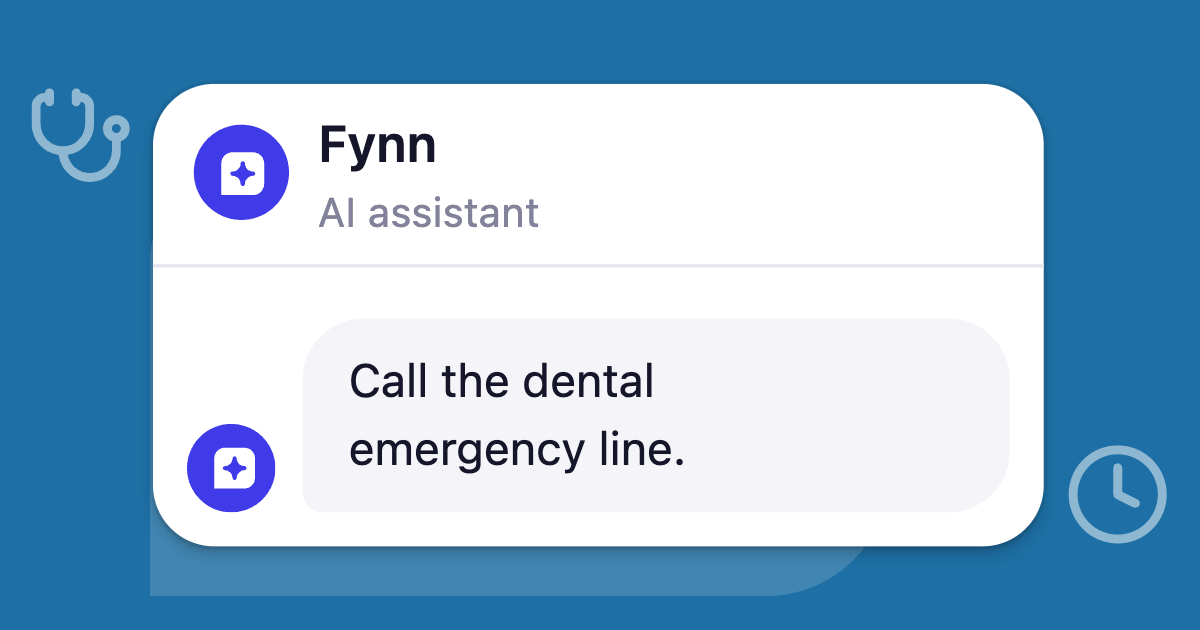
Deskwoot is our help desk. Its AI assistant Fynn follows the design above, so your reply reaches a patient in pain at 9 pm while nobody watches the chat.
Your reply on day 1
The guided setup for practices asks for your pain answer among the first questions. Keep each version under 60 words, the most Fynn writes in one reply. The Training Hub also takes them as an FAQ list.
No medical talk
Fynn shares your routes exactly as your content states them, adds the emergency number and decides nothing itself. It never asks about symptoms, medication or insurance numbers, never quotes them back and gives no diagnosis, dosage or painkiller advice.
After closing
Business hours (Startup and up) are weekly per inbox, without holiday dates, so switch holiday days off by hand. Outside them, Fynn says nobody is available right now and the patient can leave a message.
An inbox without Fynn sends your unavailable message word for word.
Monday and your phones
Each handover comes with a short note on the issue, the patient's mood and a next step. Labels (Startup and up) sort the weekend, and round robin hands it out oldest first as teammates come online.
For practices, phone pushes show only the conversation number by default (without content). Every Fynn reply shows it comes from an AI assistant (how patients see it).
Cost and a first try
Fynn comes with the Startup plan at $4 per agent per month, or $3.20 billed annually. That includes 50 AI conversations a month for the workspace, and each extra one costs $0.07 (pricing, page for practices).
To try it, sign up, paste your 3 versions and run the 7 tests above. Fynn stops replying in a chat it handed over, so continue in a new private window.
New workspaces get 7 days of the Enterprise plan for up to 30 seats including yours, without a credit card. After that they can stay on the free Hacker plan, which has no Fynn.
Also available in:DeutschEspañolFrançaisPortuguês (Brasil)