Allergen questions on WhatsApp and chat: what Germany's LMIDV requires and what an AI may say
What § 4 LMIDV and Art. 14 of the EU FIC Regulation require when guests ask about allergens or order on WhatsApp, by email or in a chat. Plus a template for your allergen list, rules for an AI assistant and the words your team uses when a guest has a severe allergy.

Contents
- What § 4 LMIDV requires from restaurants in Germany
- When the question comes in on WhatsApp, by email or in a chat
- A template for your allergen list
- The rule for the assistant: it only repeats the list
- What your team says when a guest has a severe allergy
- Outside Germany
- The test for tomorrow morning
- How to set this up with Deskwoot
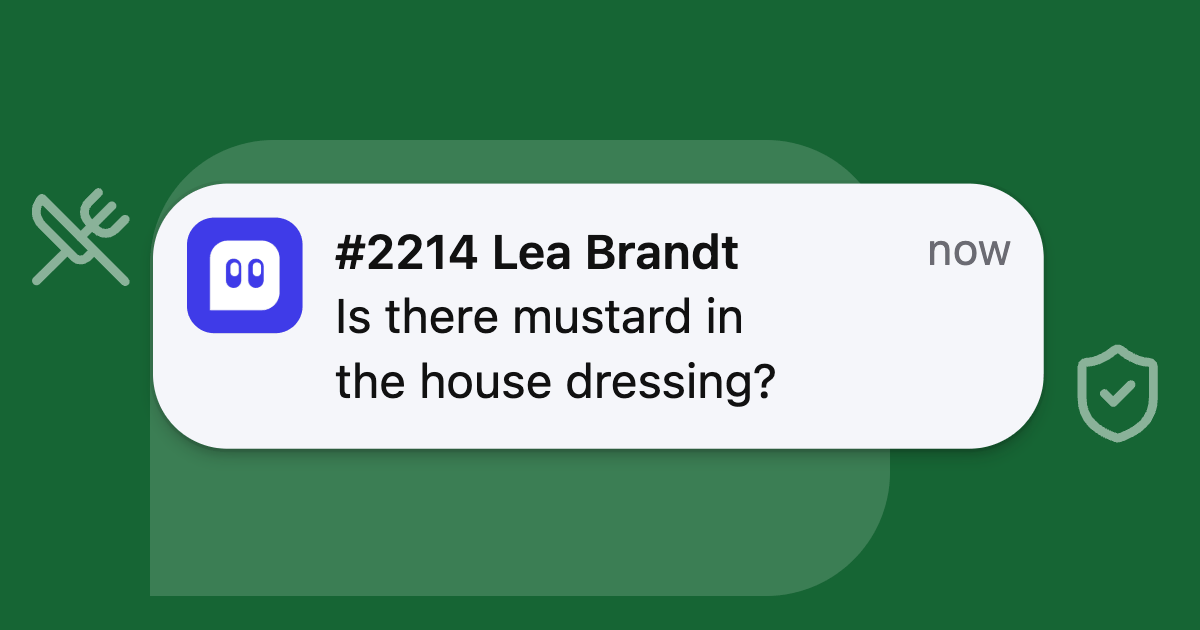
Friday, 5:50 pm. A mother writes on WhatsApp: “Is there mustard in the house dressing? My daughter reacts badly to it.” Between two plates, the new temp types “don't think so”. The dressing is made with mustard.
In Germany, § 4 LMIDV spells out exactly how you state allergens on the menu and at the table. It says nothing about chat. Below you'll find the rules, a template for your allergen list, instructions for an AI assistant and set phrases for your team.
What § 4 LMIDV requires from restaurants in Germany
For food served without packaging, the EU Food Information to Consumers Regulation (FIC, called LMIV in German) makes one piece of information mandatory: the ingredients listed in Annex II that cause allergies and intolerances (Art. 44(1)(a) with Art. 9(1)(c) FIC).
In Germany, § 4 of the Food Information Implementing Regulation (LMIDV) sets out how you provide it.
The rules here apply in Germany (LMIDV) and the EU (FIC). Further down there's a short overview for Austria, Switzerland, the UK and California. This is general information, not legal advice. For questions about your own business, your local food safety authority can help.
The 14 allergens
The rules cover the 14 groups in Annex II of the FIC. The leaflet from Berlin's veterinary and food inspection office lists them with examples:
- cereals containing gluten
- crustaceans
- eggs
- fish
- peanuts
- soybeans
- milk including lactose
- tree nuts
- celery
- mustard
- sesame
- sulfur dioxide and sulfites above 10 mg per kilogram or liter
- lupin
- mollusks
In writing (paragraph 3)
In writing, you state the allergens on the menu, on a sign, on a posted notice or through an electronic format that guests can reach directly and easily. Guests have to be able to see them before they buy and before the food is handed over.
If you go the electronic route, say with a QR code that opens the list, the dish or a notice has to tell guests how to get to the information. Footnotes are allowed as long as each dish clearly points to them.
Verbally (paragraph 4)
Verbal information comes from you or from staff who are “sufficiently informed” about the ingredients. In that case, these conditions apply:
- Guests get the answer right away when they ask, before they buy and before the food is handed over.
- For every dish there is a written or electronic record of the ingredients.
- The authorities can access that record easily, and so can guests when they ask.
- A clearly visible notice in the restaurant says that allergen information is given verbally.
The Berlin leaflet suggests wording for that notice (our translation):
“You can ask about ingredients in our products that cause allergies or intolerances at any time. We are happy to give you this information verbally. Written documentation is also available on request.”
According to the Schwerin Chamber of Industry and Commerce (IHK), a table with boxes to tick is enough as documentation.
Germany's federal agriculture ministry mentions a notebook, an information sheet or recipe details, as long as they show which ingredients cause allergies.
Where it goes wrong in practice
In daily service, these are the usual weak spots:
- The menu uses letters like “a, g”, but the key is missing.
- There's a separate allergen menu, but the regular menu doesn't point to it. According to the Berlin leaflet, every regular menu needs that note.
- Staff give information verbally, but there's no record. “Purely verbal information is not permitted without written documentation,” writes Verbraucherzentrale NRW, the consumer advice center for North Rhine-Westphalia. It also advises updating the documentation regularly, because manufacturers change their recipes.
- The menu only says “May contain traces”. As a blanket statement, that isn't enough according to Verbraucherzentrale NRW, and the Berlin leaflet says the voluntary trace warning doesn't exempt you from labeling.
When the question comes in on WhatsApp, by email or in a chat
If a guest asks about sesame on WhatsApp the day before, the information still has to be ready in the restaurant that evening, before they order. The chat answer comes on top of that.
It has to match your documentation, or the guest ends up with two different answers. So whoever answers an allergen question in the chat copies the line from the documentation.
With the list in hand, the temp from the start would have been done in 20 seconds, and the answer would have been right.
WhatsApp orders count as distance selling
When guests order by WhatsApp, phone or website, more rules apply. Under Art. 2(2)(u) FIC, any means that lets a contract be concluded without both sides being present at the same time counts as a means of distance communication.
For food without packaging, Art. 14(2) FIC refers to paragraph 1. That means:
- The allergen information is available before the purchase contract is concluded, on the material supporting the distance sale or through another suitable means that you clearly identify.
- It costs the guest nothing extra.
- The information is also available on delivery.
In practice, it looks like this:
- Before you confirm an order in the chat, send the link to your allergen list, ideally as a fixed part of your reply template.
- According to the Berlin leaflet, delivery menus and flyers need the labeling too.
- On delivery, a printed copy of the list goes in the bag, or each dish carries a sticker with its allergens.
If you're unsure what this has to look like for pickup orders, check with your local food safety authority.
A template for your allergen list
Ideally you keep one single list: for the documentation in the restaurant, for the link in the chat and for an AI assistant.
What the list needs
- It's made of text: exported as a PDF from Word, Google Docs or Canva, not scanned. If you can highlight a dish with your mouse, software can read it too.
- Allergens are written out as words. Everyone understands “mustard”, but “g” only works with a key.
- Each dish has exactly the name it has on the menu, or nobody finds the line.
- Each allergen says where it is. “Mustard (in the dressing)” helps your servers more than “mustard”.
- A date sits at the top. When a recipe or a supplier changes, you make a new version, and the old one disappears from the folder, the restaurant and the chat.
- Drinks and changing dishes belong on it: the house wine with sulfites just as much as the lunch special, which gets its own list with the week in the title.
What it can look like
Header and table with sample data:
Allergens in our dishes, Sample Trattoria
Last updated: October 25, 2026. Questions about this list go to our kitchen: [phone number].This list names the major allergens under Annex II of the FIC that each dish contains. It doesn't list traces from contact in the kitchen. If you have a severe allergy, please tell our staff before you order.
| Dish | Contains | Where |
|---|---|---|
| Side salad with house dressing | Mustard, sulfur dioxide and sulfites | Mustard and balsamic vinegar in the dressing |
| Cream of celery soup with croutons | Celery, milk, wheat (gluten) | Cream in the soup, wheat in the croutons |
| Seafood linguine | Wheat (gluten), eggs, crustaceans, mollusks, sulfur dioxide and sulfites | Egg pasta, shrimp, mussels, white wine in the sauce |
| House red wine, 0.2 l | Sulfur dioxide and sulfites | Wine |
The rule for the assistant: it only repeats the list
With allergens, an AI assistant has a small job: give back the matching line, at 11 pm just as at 6 pm, and pass everything else to your team.
You still need the information required by § 4 LMIDV in the restaurant.
Instructions to copy
These 6 rules fit into the instructions field of almost any tool:
1. Only state allergens and ingredients as they appear in our allergen list, always with the name of the dish and the date of the list.
2. If a dish, drink or allergen isn't on the list, say that you don't know for sure and pass the question to the team.
3. Never say that a dish is safe, fine to eat or harmless for someone. Don't give tips about allergies, intolerances or symptoms.
4. About traces and contact in the kitchen, say only what's on the list.
5. If a guest writes that they or someone at their table has a severe allergy, hand the conversation to the team and ask the guest to tell our staff when ordering, too.
6. When someone asks about allergens, include the link to the list: [link].
How it answers, and how it doesn't
| Guest writes | Not like this | Like this |
|---|---|---|
| “Is there mustard in the house dressing?” | “No, it's a simple oil and vinegar dressing.” | “According to our allergen list (updated October 25, 2026), the side salad with house dressing contains mustard and sulfites, both in the dressing. The full list: [link]” |
| “Is there anything with nuts in the tiramisu?” (not on the list) | “No, there are definitely no nuts in it.” | “The tiramisu isn't on our allergen list yet. I'm passing your question to our team, and they'll get back to you here.” |
| “My son has a severe peanut allergy. What can he eat at your place?” | “Go for the linguine, there's nothing in it.” | “Thanks for letting us know in advance. I'm passing this straight to our team, and they'll get back to you here. Please also tell our staff when you order.” |
What your team says when a guest has a severe allergy
When someone mentions a severe allergy, the kitchen decides. Whether a dish can be made without contact with the allergen depends on routines only the kitchen knows.
Verbraucherzentrale NRW points to keeping the work steps apart in space or in time. So that nobody improvises in the rush, your team gets set wording:
In the chat: “Thanks for letting us know in advance. According to our allergen list (updated [date]), [dish] contains [allergens]. [Name] from our kitchen will check with you before you order whether the kitchen can make [dish] for you without [allergen]. Please mention it to our staff at the table again, too.”
At the table: “Thanks for telling me. Let me quickly get [name] from the kitchen, who can tell you exactly.”
If you speak to guests more formally, adjust the wording. “No problem”, “should be fine” and any advice on what the guest should eat are left out on purpose.
Whoever takes the message writes the allergy on the reservation or the order ticket so it reaches the kitchen.
Outside Germany
- In Austria, a trained person always has to be on site when allergen information is given verbally (Austrian Economic Chamber).
- In Switzerland, Art. 5 of the Food Information Ordinance (LIV) requires a clearly visible written notice for verbal information, plus information that staff have in writing or that a qualified person such as the chef provides (fact sheet from the canton of Aargau).
- In England, Wales and Northern Ireland, 14 allergens apply as well, according to the Food Standards Agency. For remote orders, the information must be available before the order is completed and on delivery.
- In California, chains with 20 or more locations there have had to disclose the 9 major US allergens since July 1, 2026 (law SB 68, summarized by the law firm ArentFox Schiff).
Anywhere else, ask your local food authority. There's more on Austria and Switzerland in AI in restaurants.
The test for tomorrow morning
Hand your newest server the allergen list and ask about 3 items, including a drink and the dish of the day.
If they find every line in under a minute, the list is ready for the restaurant and the chat. If one is missing, you know what you're writing today.
How to set this up with Deskwoot
Deskwoot is our tool. WhatsApp, email, your website chat and other channels land in one inbox there, and the AI assistant Fynn answers from your content. See how it handles an allergen question in the live demo on the restaurants page.
Upload the list
Upload your allergen list in the Training Hub as a PDF, Word, TXT or CSV file of up to 10 MB. If it's a scan without a text layer, Deskwoot rejects it at upload and shows a message saying why.
Deskwoot rereads your website every 48 hours, but not an uploaded document. When a recipe changes, upload the new list and delete the old one.
The rules are already built in
If you pick “Restaurant & café” during setup, the key rules are already in Fynn's instructions. It names allergens and ingredients only from your menu and allergen text, together with the name of the dish.
If something is missing, it says it doesn't know for sure and that the team will check. Guessing is off limits, and it declines to give medical advice. Add the list date, the link and the severe allergy rule from the template above under Settings > Bots.
When Fynn hands a conversation to the team, it leaves a note with the request, the guest's mood and a suggested next step. The free app for iPhone and Android sends you a push notification, even in the middle of service.
Fynn doesn't replace the information you have to provide in the restaurant under § 4 LMIDV. Deskwoot and its database run in data centers in the Netherlands.
What it costs
- Fynn comes with the Startup plan and up, at $4 per agent a month or $3.20 billed annually, with 50 AI conversations a month for the workspace.
- Each additional AI conversation costs $0.07 from a prepaid balance.
Your next step
Create a workspace at deskwoot.com/signup, upload your list and ask Fynn the 3 questions from the test above.
For the first 7 days, your workspace runs on Enterprise, with Fynn, without a credit card and for up to 30 people including you. After that, you choose a plan or stay on the free Hacker plan, which doesn't include Fynn.
Also available in:DeutschEspañolFrançaisPortuguês (Brasil)